ESG Consultant


ESG Consultation

ESG Made Measurable, Actionable and Business-Ready.

Aligned with Malaysian Requirement

Structured to meet Bursa Malaysia expectations while aligning with global framework (GRI, TCFD, SDGs).

Practical, Not Theoretical

We translate ESG into clear actions, KPIs, and reporting your team can implement immediately.

End-to-End
One-Stop ESG Partner

From awareness training to reporting and implementation—fully integrated, seamless execution.
We can guide
Clear Workflow & Duration

ESG Made Measurable, Actionable and Business-Ready.

Evaluate current practices, compliance status, and risk exposure

Estimated duration: 2 weeks 

Identify key ESG issue and align with business objective

Estimated duration: 2 weeks

Develop ESG initiative, metric, and governance structure

Estimated duration: 2 weeks 

Prepare sustainability report and strengthen ongoing ESG performance

Estimated duration: 2 weeks 

What's ESG?

Step into real ESG—beyond theory. Join our 2-Hour ESG Talk & Zero-Waste Pineapple Farm Tour and experience how sustainability is turned into real business value. 

✔️ Learn from industry experts 

✔️ See zero-waste farming in action 

✔️ Discover how ESG can drive growth for your business 📅 

Choose Your Package

  • Less than 100 Employees 
  • HRDC Claimable
  • Guided, Hassle-Free ESG Journey
  • Clear ESG Direction
  • Structured ESG Framework
  • Ready-to-Use Sustainability Report
  • Less than 200 Employees 
  • HRDC Claimable
  • Guided, Hassle-Free ESG Journey
  • Clear ESG Direction
  • Structured ESG Framework
  • Ready-to-Use Sustainability Report
  • Less than 300 Employees 
  • HRDC Claimable
  • Guided, Hassle-Free ESG Journey
  • Clear ESG Direction
  • Structured ESG Framework
  • Ready-to-Use Sustainability Report

Our clients

We are grateful
ISO Consultant
Fire Fighter
Swiss Garden
ISO Consultant

FAQ
ESG Consultant Malaysia

ESG Made Measurable, Actionable and Business-Ready.

ESG Consulting Malaysia helps organizations develop and implement Environmental, Social and Governance strategies to improve sustainability performance, reduce environmental impact, manage climate risks and create long-term business value.

An ESG Consultant supports companies in ESG assessment, sustainability roadmap development, carbon management, ESG reporting and implementation of improvement initiatives.

ESG is becoming increasingly important as customers, investors, multinational corporations and supply chains demand stronger sustainability performance.

Effective ESG implementation helps companies:

  • Reduce greenhouse gas emissions
  • Improve energy efficiency
  • Strengthen corporate governance
  • Reduce operational risks
  • Meet customer ESG requirements
  • Improve competitiveness in global markets

An ESG Consultant helps organizations:

  • Conduct ESG gap assessments
  • Develop ESG strategies and roadmaps
  • Measure carbon footprint
  • Calculate greenhouse gas (GHG) emissions
  • Develop Scope 1, Scope 2 and Scope 3 emission strategies
  • Support ESG reporting
  • Identify sustainability improvement opportunities
  • Integrate ESG with ISO management systems

According to the GHG Protocol, greenhouse gas emissions are categorized into three scopes:

Scope 1 Emissions
Direct emissions from sources owned or controlled by the organization, such as:

  • Factory fuel consumption
  • Company vehicles
  • Manufacturing processes

Scope 2 Emissions
Indirect emissions from purchased energy, mainly:

  • Electricity consumption
  • Purchased steam, heating or cooling

Scope 3 Emissions
Other indirect emissions throughout the value chain, including:

  • Supplier emissions
  • Raw material sourcing
  • Transportation and logistics
  • Business travel
  • Employee commuting
  • Product lifecycle impact

Scope 3 is often the largest emission category and requires collaboration with suppliers and business partners.

GHG Protocol is a globally recognized framework used by organizations to measure, manage and report greenhouse gas emissions.

It provides guidance for companies to:

  • Establish carbon emission boundaries
  • Calculate carbon footprint
  • Identify emission sources
  • Develop carbon reduction strategies
  • Track sustainability performance

Carbon footprint calculation involves identifying and measuring greenhouse gas emissions from business activities.

A typical assessment includes:

  • Energy consumption analysis
  • Electricity usage
  • Fuel consumption
  • Manufacturing processes
  • Transportation activities
  • Waste generation
  • Supply chain impact

The result helps organizations establish emission reduction targets and sustainability strategies.

An ESG Roadmap is a strategic plan that guides organizations in improving sustainability performance.

A typical ESG roadmap includes:

  1. ESG gap assessment
  2. Materiality assessment
  3. Carbon emission measurement
  4. Sustainability objectives
  5. ESG improvement initiatives
  6. Implementation timeline
  7. Performance monitoring

ESG helps manufacturers improve operational sustainability through:

  • Energy efficiency improvement
  • Waste reduction
  • Carbon emission reduction
  • Smart manufacturing adoption
  • Sustainable supply chain management
  • Environmental compliance improvement

ESG also helps factories meet sustainability requirements from multinational customers.

Industry 4.0 technologies can accelerate ESG performance by enabling:

  • Real-time energy monitoring
  • Smart factory solutions
  • IoT-based data collection
  • Production optimization
  • Reduced resource wastage
  • Data-driven sustainability decisions

Digital transformation and ESG work together to improve operational efficiency and reduce carbon impact.

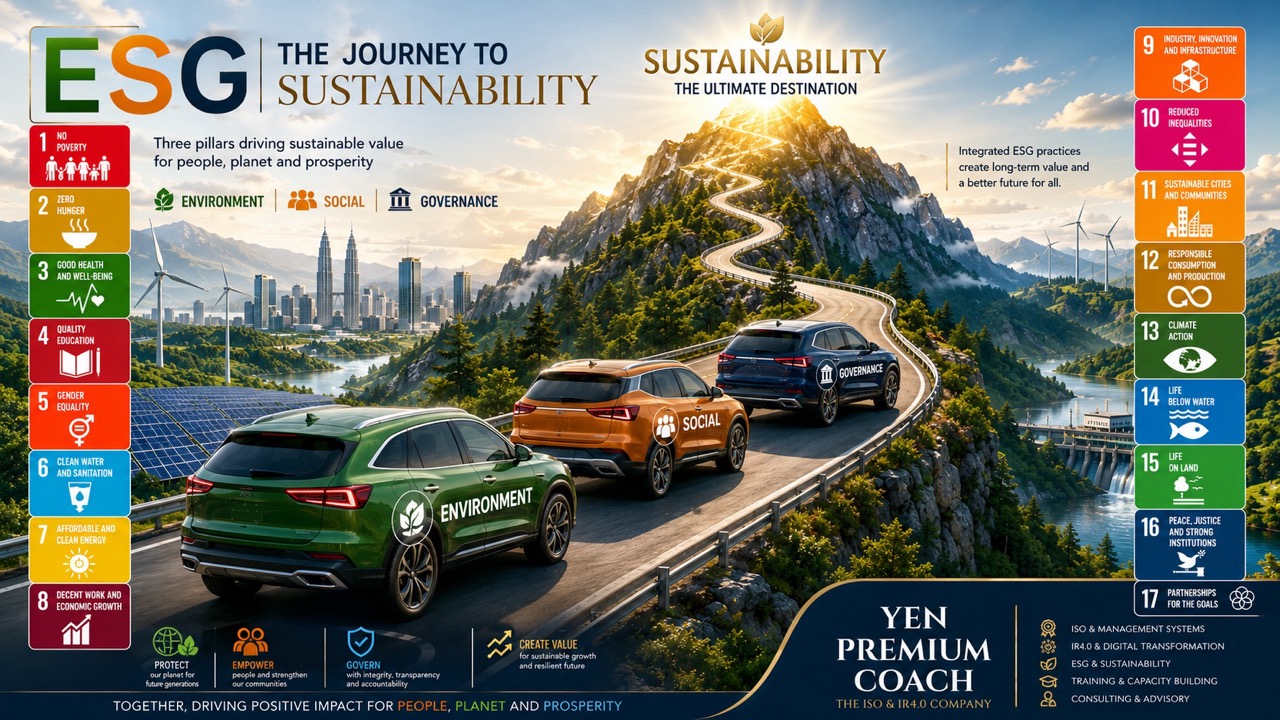
Sustainability is the broader concept of creating long-term environmental, social and economic balance.

ESG provides measurable criteria to evaluate sustainability performance through:

Environmental

  • Carbon emissions
  • Energy management
  • Waste reduction

Social

  • Employee wellbeing
  • Safety
  • Human rights

Governance

  • Ethics
  • Compliance
  • Transparency

Common ESG reporting frameworks include:

  • GRI Standards (Global Reporting Initiative)
  • ISSB Sustainability Standards
  • TCFD Climate-related Financial Disclosures
  • Bursa Malaysia Sustainability Reporting Requirements

Companies select suitable reporting frameworks based on industry, stakeholder expectations and business objectives.

ESG requirements depend on company type, industry, customer expectations and regulatory requirements.

Many companies adopt ESG voluntarily to:

  • Improve business competitiveness
  • Meet MNC customer requirements
  • Prepare for future regulations
  • Strengthen sustainability performance

ESG complements various ISO management systems:

ISO 14001
Environmental Management System

ISO 50001
Energy Management System

ISO 45001
Occupational Health & Safety Management System

ISO 37001
Anti-Bribery Management System

ISO 9001
Quality Management System

Together, these systems strengthen organizational sustainability and governance.

Yes. ESG is not only for large corporations.

SMEs can start with practical initiatives:

  • Energy saving programs
  • Waste reduction
  • Recycling improvement
  • Sustainable purchasing
  • Employee safety improvement
  • Ethical business practices
  • Basic ESG reporting

A phased ESG approach allows SMEs to improve sustainability without excessive complexity.

Yen Premium Coach Consulting combines:

  • ESG consulting expertise
  • ISO management system experience
  • IR4.0 smart technology knowledge
  • Carbon reduction strategy
  • Sustainability improvement approaches

We help organizations develop practical ESG strategies, measure environmental impact, reduce greenhouse gas emissions and build sustainable business models aligned with global climate goals.

You may have some read here, then you will have a clearer picture that ESG is now a competitive advantage, rather than an optional practice. 

ESG Made Measurable, Actionable and Business-Ready.

Driving the 1.5°C Global Warming Goal Through ISO Standard and IR4.0 Innovation